


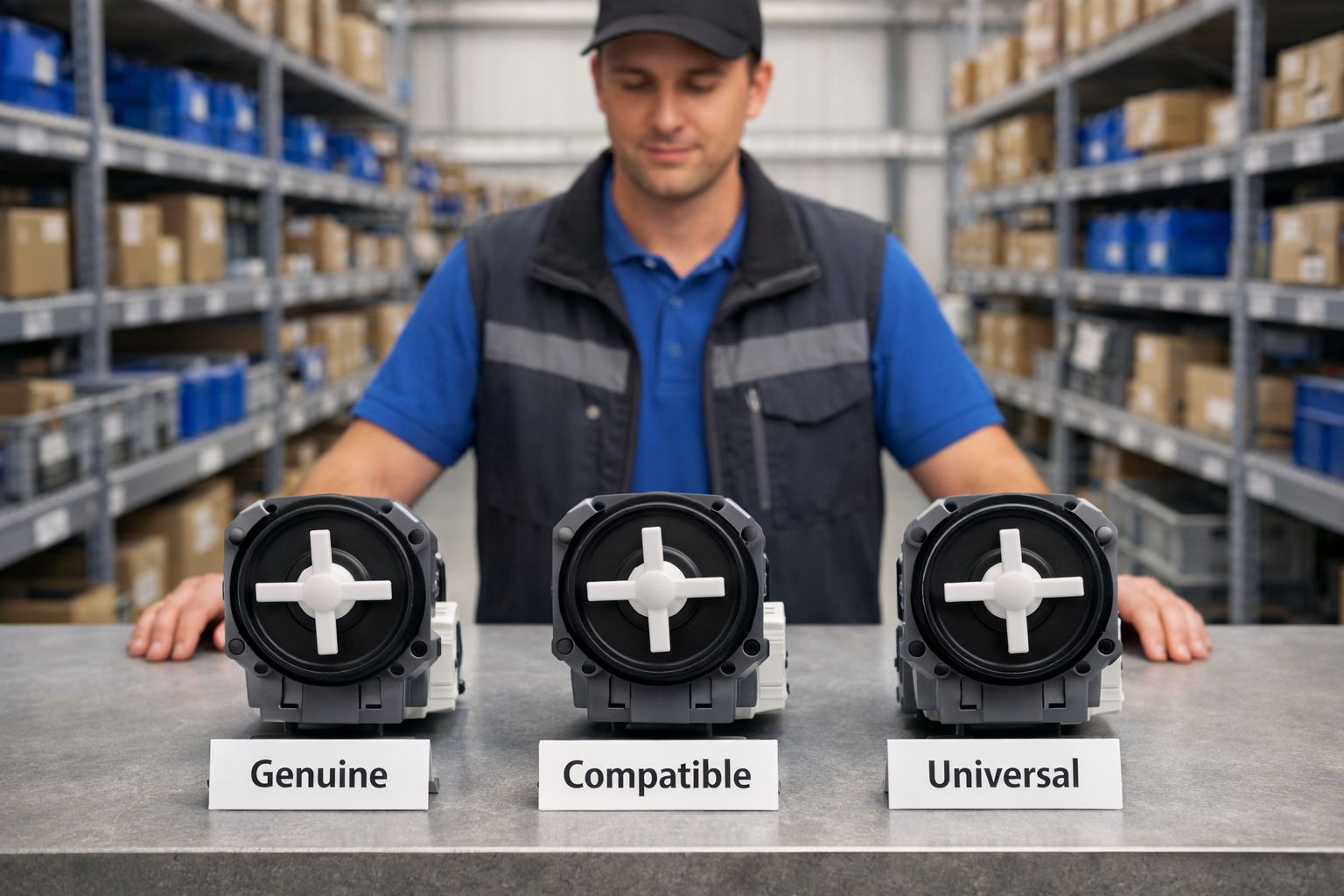
A common buying question is which type of replacement to choose. Customers often know they need a door seal, shelf, belt, filter, heater, pump, basket wheel, thermostat or control knob, but are unsure which option is right: genuine, compatible or universal.
These are not just different labels. They are different ways of matching a replacement part to the appliance in front of you. The right choice depends on the part itself, the exact model, the level of fit required, and whether the replacement is being matched by model number, original part number, dimensions, ratings or connector type.
The strongest buying method is simple. Search by your exact model number first. Spares2Repair Confirmed Fit is designed to reduce guesswork by helping you move straight to parts that are suitable for your appliance, including Genuine, Compatible and Universal options where available.
Why these terms matter before you order
Plenty of wrong-part orders begin with a sensible assumption that turns out to be false:
- the shelf looks the same as the broken one
- the belt is roughly the same length
- the heater has the same shape
- the seal looks close enough in the photo
- the universal version says it fits many models
In practice, appliance spare parts are rarely that forgiving. Small differences in mounting position, power rating, connector layout, product-code revision, material, shape, profile, dimensions or model family can turn a part that looks right into a part that does not fit, does not seal, does not connect, or does not perform properly.
That is why good spare-parts buying is not only about identifying the part family. It is also about understanding how the replacement has been matched.
What a genuine part usually means
A genuine part is usually the original manufacturer part, or a part supplied through an authorised source for the appliance brand and model family. In practical terms, it is the replacement that follows the original part-number and model-number path most directly.
This does not mean every repair always requires a genuine part. It does mean that genuine parts are often the clearest option when exact fit, exact finish, exact electrical specification, or exact brand-specific design matter most.
Typical examples where the genuine option is often especially valuable include:
- control knobs, trims, shelves, drawers and door furniture where the fit and finish are very specific
- door seals and moulded rubber parts where profile shape matters, not just general size
- control boards, modules, selectors and other brand-specific electronic parts
- parts where the original manufacturer part number is the strongest identification method
If your main concern is exact fit, exact appearance, exact connector layout, or an exact manufacturer replacement, genuine is often the clearest choice.
What a compatible part usually means
A compatible part is typically a non-original replacement designed to replace one or more original part numbers or fit a stated list of appliance models. It is not the same as a universal item. A compatible part should still be tied to a clear compatibility match.
The important question is not whether a part is labelled compatible. The important question is compatible with what, exactly.
To help show when a compatible option is relevant, a stronger product listing will usually make one or more of the following clear:
- the original part number it replaces
- the appliance models it fits
- the brands or product families it covers
- the relevant dimensions or specification where model fit alone is not enough
Compatible parts can be a practical option for common replacement items where the fit is already well understood and the replacement has been identified properly. That can include certain filters, belts, basket wheels, hoses, lamps, carbon filters, door seals and heater elements.
The key point is this: a compatible part can be a sensible, low-risk choice when it is tied to your exact model number, original part number, or a clear compatibility checker. The risk comes when the listing is vague, or the part is chosen mainly by appearance.
What a universal part usually means
A universal part is not normally matched to one exact model list in the same way as a model-specific genuine or compatible part. Instead, it is usually intended to work across multiple appliances where the key fitting conditions are shared.
That usually means the part must be matched by one or more practical checks such as:
- length
- diameter
- connector style
- mounting method
- shape or profile
- wattage, voltage or rating
- left-hand or right-hand configuration
Universal does not mean it fits everything. It means the part can suit a wider range of appliances, but only when the key measurements, fitting points, ratings or connection details match properly.
This is where customers can come unstuck. A universal part may look close enough in a photo, but if the dimensions, connector style, fixing method or electrical rating are wrong, it is still the wrong part. That is why universal parts should be treated as a specification match, not just a visual match.
Universal parts can still be a very practical buying option in the right situation. Some lamps, hoses, vent hoses, cooker hood filters, floor tools, knobs and other accessories can work well when the technical details line up correctly. The key is to check the measurements and fitting details carefully before you order.
When universal parts are most likely to go wrong
Universal parts are most likely to cause problems when customers buy on appearance alone, or assume that a broad fit claim removes the need to check the detail.
Some of the most common problem areas include:
- door seals where the profile, corner shape and fitting method matter
- shelves and drawers where width, depth and moulded shape matter
- heaters and electrical parts where rating, terminal position and connector layout matter
- pumps, valves and motors where mounting points, outlet positions and wiring can vary
- filters or accessories where one appliance family has multiple similar-looking versions
In other words, the broader the fit claim, the more important it becomes to check what is actually being matched.
What to check before ordering any part
Whether the part is genuine, compatible or universal, the checking process should stay simple and consistent. Before ordering, it is worth confirming as many of the following as possible:
- the full model number from the rating plate
- the original part number, if you have it
- the appliance brand and exact model variant
- the visible shape, profile and fitting style
- dimensions where relevant
- electrical rating where relevant
- left-hand or right-hand orientation where relevant
- colour or finish where appearance matters
This matters because the same part family is not always the same part. Two oven elements can look almost identical but have different ratings or terminal positions. Two fridge shelves can look the same in a photo but differ just enough in width or shape to make them unusable. Two belts can both be described as tumble dryer belts while still having different lengths or profiles.
Why the model number still matters even when the part looks obvious
Appliance manufacturers often produce model families that look very similar from the outside, while using different internal parts, revised versions or product-code variations behind the scenes. That is why the full model number matters far more than a rough description on the front of the machine.
A customer might search for a dishwasher spray arm, washing machine door seal or oven heater element and feel sure they have found the right part by eye. The problem is that small differences between versions are often enough to make that choice wrong. Matching by the exact model number removes a lot of that uncertainty.
That is exactly why Spares2Repair puts so much emphasis on Confirmed Fit. It is designed to take the guesswork out of the buying process by showing you parts that are suitable for your appliance once the correct model has been matched.
If you have not found the full rating-plate details yet, use Model Number Location first. If the plate is faded, hidden or difficult to read, open Fixit Fox Finder before you order.
Which part categories are most sensitive to exact fit?
Some spare-part categories are far less forgiving than others. These are good examples of parts where the exact model and exact specification matter before you buy:
- Washing machine door seals
- Fridge freezer shelves, fridge door shelves and fridge freezer drawers
- Oven heater elements
- Dishwasher spray arms
- Dishwasher door locks
These are the kinds of categories where “it looks the same” is one of the most expensive assumptions a customer can make.
Which part types are more often matched by dimensions or general fitting details?
Some replacement categories are more likely to follow a dimensions-and-specification check than a strict model-list match. That can include selected:
- vacuum cleaner tools and hoses
- cooker hood filters
- lamps
- belts
- vent hoses
- certain universal knobs and fittings
Even in those categories, the safest buying habit is still to check the detail that actually controls the fit. The more universal the product sounds, the less you should rely on the image alone.
A practical way to choose between genuine, compatible and universal
In most cases, the decision becomes much easier once you work through it in the right order:
- find the exact appliance model from the rating plate
- identify the part family you need
- check whether the original part number is known
- look first at the genuine and compatible parts confirmed for your model
- only choose a universal part when the measurements, ratings and fitting details all match properly
- pause and double-check if there are several similar-looking versions
That process helps avoid the three most common causes of wrong-part orders:
- buying on appearance alone
- missing model-code or version differences
- treating a universal description as a guarantee rather than a specification-based option
What to do if you are still unsure
If the part is electrical, model-sensitive, cosmetic, or available in several near-identical versions, it is better to stop and verify than force a guess.
Use How To Find Spare Parts if you want a step-by-step way to move from model number to the right part family. If the problem starts with a fault rather than a part name, begin in the Repair Advice Centre. If you want guided help, open Fixit Fox Finder.
Need help choosing the right type of replacement?
Start here
Find the full model number
The model number is the strongest starting point for showing the right Genuine, Compatible and Universal parts for your appliance.
Part matching
Use the spare-parts guide
Move from your appliance model to the correct part family, then narrow down the best replacement option with much more confidence.
Guided help
Ask Fixit Fox Finder
Get help identifying your model, narrowing down the part family and choosing the safest option before you order.
The best replacement is the one that is matched properly
There is no single rule that says genuine is always necessary, compatible is always better value, or universal is always risky. The right answer depends on how the part is being matched and how exact the fit needs to be.
If the part depends on exact model fit, exact finish, exact electrical detail or an exact manufacturer replacement, the genuine option is often the clearest choice. If a compatible part has been properly matched to the right original part number or model list, it can be an excellent replacement. If a universal part is being matched by the correct measurements, ratings and fitting method, that can also be the right decision.
The mistake is not choosing one label over another. The mistake is ordering before the fit has been checked properly. That is why searching by exact model number first is usually the strongest buying decision you can make.
FAQ
Is a genuine part always the best choice?
Not automatically. Genuine parts are often the clearest choice where exact fit, exact finish, exact electrical specification or brand-specific design matter most. The best option depends on the part and how it has been matched.
Does compatible mean the same as universal?
No. A compatible part is usually matched to specific original part numbers, models or product families. A universal part is usually matched by shared fitting conditions such as dimensions, ratings, connector type or mounting style.
Can I choose a part just because it looks the same?
No. Similar appearance is one of the biggest causes of wrong-part orders. Small differences in dimensions, profile, fixing points, connectors or model-code revision can still make the part wrong.
Why does the full model number matter so much?
Because appliances that look very similar can still use different internal parts, revised versions or model-variant components. The full model number is one of the strongest ways to narrow down the correct replacement.
When should I be most careful with universal parts?
Be most careful when the part depends on a precise shape, profile, electrical rating, connector layout or moulded fit. Seals, shelves, drawers, heaters, pumps and electronics are all common examples where assumption causes wrong-part orders.