

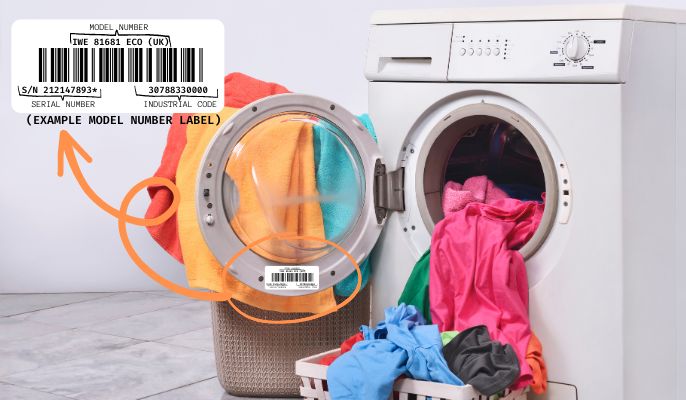
What is a rating plate, and is that where I find my model number? In most cases, yes. When an appliance breaks, many people assume the hard part is fitting the replacement component. Often the first and most important point of failure happens much earlier, at the rating plate.
Start with the full appliance identity: if the search begins with the wrong model number, the wrong partial code, or the wrong field from the label, the spare-part journey can move into the wrong results before the purchase has even begun.
The rating plate or model sticker is one of the most important pieces of information in the appliance repair process. It identifies the appliance properly before you start looking for shelves, seals, filters, pumps, belts, handles, elements, knobs, baskets, wheels, or thermostats. That sounds simple, but this is exactly where many customers get stuck.
The label may be small, faded, dusty, hidden behind a door, printed on a curved surface, or packed with several different identifiers. Customers then have to work out which line is the model number, which is the serial number, whether suffixes matter, and whether every character needs to be copied exactly.
For appliance spare parts, precision usually matters a great deal. A missing suffix, a confused zero and letter O, a dropped slash, or a serial number pasted into the search box instead of the model number can point the customer toward the wrong parts. Once that happens, every later step becomes weaker.
Why the rating plate is the real starting point of repair
A successful repair journey does not start when the part arrives. It starts when the appliance is identified correctly. That is what the rating plate is for. It anchors the appliance identity before the customer starts browsing product categories or comparing part images.
This matters because modern appliances often come in closely related families. Two products can look almost identical from the outside and still use different internal parts. A shelf may be the wrong width. A door seal may mount differently. An oven element may have a different layout. A dishwasher basket part may fit one revision but not another. A washing machine pump may look similar but connect differently.
That is why visual similarity is weaker than model-number-first matching. Product photos can support identification, but they should not replace it. Your own guidance on common spare-part buying mistakes makes the same point from a customer perspective: the closer the fit depends on the exact model variant, the less safe it is to rely on appearance alone.
What the rating plate actually tells you
The rating plate is not just a legal or technical label. In appliance spare parts, it is the link between the physical appliance in the home and the correct product path online. Depending on the manufacturer, it may include the model number, serial number, type number, production number, service code, and electrical details.
The customer does not always need every line on the sticker, but they do need to identify the correct one and copy it accurately. That is where errors begin. People frequently copy the serial number instead of the model number, omit suffixes, ignore slash codes, or take only the largest line of text when the smaller identifiers are the ones that separate one revision from another.
The most common rating plate mistakes
Customers should always try to enter the full model number before looking for parts. Without that, the search often becomes broad, uncertain, and much more likely to produce the wrong results.
1. Using only part of the model number
Customers often copy the largest visible chunk and assume that is enough. Sometimes it is not. Small suffixes, slashes, trailing digits, and revision markers can matter. Dropping them can widen the results too much or point to a nearby but wrong variant.
2. Confusing the model number with the serial number
Many appliance labels contain several codes. There may be a model number, serial number, service code, product number, type number, or production number. If the wrong field is used, even a perfectly copied number can still lead to the wrong result set.
3. Misreading characters
Faded plates and cramped labels create easy transcription errors. Zero and the letter O, one and the letter I, five and the letter S can all be confused. Customers may also miss a dash, slash, or dot that matters.
4. Giving up and switching to appearance-based browsing
Once the label becomes frustrating, some customers abandon the identification step and search for a generic-looking part instead. This is one of the most common routes into a wrong-part order, because many parts look similar across different appliance families.
Why the rating plate problem is bigger than it looks
It is easy to dismiss the rating plate as a small support detail. In reality, it is one of the highest-value pieces of information in the whole appliance spare-parts process because it affects every later decision. If the label is read correctly, the customer can move toward the right category, the right part family, and a much stronger compatibility route. If it is read badly, everything that follows becomes less reliable.
For many appliances, the rating plate is the most dependable starting point for finding the correct spare part. This is especially true across high-volume categories such as washing machine spare parts, dishwasher spare parts, fridge freezer spare parts, and cooker and oven spare parts, where many parts can appear visually similar across multiple model families.
Why this affects repair confidence and waste reduction
The connection to waste is straightforward. The Global E-waste Monitor 2024 reports that the world generated 62 billion kg of e-waste in 2022 and that only 22.3% was formally collected and recycled in an environmentally sound way. In the UK, Material Focus reports that household electrical and electronic equipment placed on the market increased by 25% between 2018 and 2024, while total WEEE collections rose by only 0.6% over the same period.
Not every label mistake becomes a waste event, but some clearly feed into repair abandonment. If the customer cannot identify the appliance confidently, repair feels less reliable. When repair feels unreliable, more people delay it, avoid it, or give up too early. Better model identification improves repair confidence, lowers the chance of ordering the wrong part, and gives the customer a better chance of extending product life instead of replacing the appliance unnecessarily.
This sits within a broader repair policy shift. The European Commission’s repair of goods framework is designed to promote repair and reuse, while the European Environment Agency has pointed to the importance of longer product lifespans and improved repairability. For appliance spare parts, that wider ambition still depends on one practical reality: the customer has to identify the appliance correctly before the right part can be chosen.
Why model number support should be treated as a core feature
Model-number guidance should not be treated as a secondary support task. It should be treated as the first stage of the spare-parts journey. Once the correct appliance is identified, the rest of the process becomes much easier to manage.
Model Number Location helps customers find the rating plate. How To Find Spare Parts helps customers move from the model number into the right part-search route. Fixit Fox Finder provides guided help when the label is difficult to read or the customer is unsure which number matters.
Our existing article on wrong spare-part orders and returns already explains this same model-first approach. The stronger the identification process at the start, the better the quality of the search results, the stronger the part selection, and the lower the risk of a wrong order.
How to find your model number sticker or rating plate
Model-number stickers are often placed in less obvious locations, so it is worth taking time to check both inside and outside the appliance before starting the search.
- Look for the full label, not just the largest number on the sticker.
- Take a clear photo of the entire plate before typing anything.
- Use good light and more than one angle if reflections block part of the text.
- Do not assume the serial number is the field needed for spare parts.
- Copy suffixes, slashes, and extra characters exactly if they appear on the model line.
- If the plate is hard to read, get guided help before ordering.
Get from a hard-to-read label to the right spare part
Guide
Find the model-number label
Use the rating plate location guides before ordering so you start with the correct appliance details.
Route
Use the spare-parts help path
Move from the full model number to the right category and fitment route instead of relying on appearance alone.
Guided help
Use Fixit Fox Finder
Upload a label photo or describe the appliance if the model number is difficult to read before ordering.
Why this causes so many wrong-part orders
Customers often buy the wrong part even when they are trying to do the right thing. The problem is not usually effort, it is identification. Better label guidance and better model-number-first support reduce the risk early, before the customer commits to a part that only looks correct.
For appliance spare parts, accurate model matching is not a decorative extra. It is one of the main ways to reduce wrong-part orders, lower returns, and improve the chance of a successful repair.
Conclusion
The rating plate may be physically small, but it is one of the biggest decision points in the appliance spare-parts journey. When that step goes wrong, the whole process becomes less reliable. When that step is supported properly, everything improves: fitment confidence, customer trust, repair success, and the chance of keeping the appliance in use for longer.
That is why the rating plate deserves far more attention than it usually gets. It is not just a support-page detail. For many repairs, it is where a successful spare-parts search begins.
FAQ
Why is the rating plate so important when buying appliance spare parts?
Because it contains the information needed to identify the exact appliance model before choosing a compatible part.
Can I buy a part just by matching the product photo?
Photos can help, but they are not a reliable substitute for model-number-first matching because many parts look similar across different model families.
What should I do if the model label is faded or hard to read?
Take a clear photo in good light, use the model-number location guides, and use Fixit Fox Finder if you need guided help before ordering.
Sources
- The Global E-waste Monitor 2024, International Telecommunication Union
- UK e-waste data trends 2018 to 2024, Material Focus
- Directive on repair of goods, European Commission
- Product lifespans: monitoring trends in Europe, European Environment Agency
- Spares2Repair News Article 16
- Stop Buying the Wrong Appliance Spare Parts | Fixit Fox Finder